
A /30 subnet mask is a prefix length commonly used in a point-to-point connection between two network devices. A /30 network divides a large network into a very smaller network containing just 4 ranges of IP addresses. The first IP address in this range is the network ID, and the last IP address in this range is the broadcast IP. Hence, there are 2 usable IP addresses in a /30 subnet mask.
For example, if we want to subnet 192.168.2.0/24 with a /30 subnet mask, the first subnet will have 192.168.2.0 as the network ID, a usable IP address of 192.168.2.1 to 192.168.2.2, and a broadcast IP address of 192.168.2.3. The second subnet will have a network ID of 192.168.2.4, a usable IP range of 192.168.2.5 to 192.168.2.6, a broadcast IP address of 192.168.2.7, and so on.
Here is the table of networks obtained by subnetting with a /30 subnet mask.
| Network Address | Usable IP address | Broadcast IP address |
|---|---|---|
| .0 | .1-.2 | .3 |
| .4 | .5-.6 | .7 |
| .8 | .9-.10 | .11 |
| .12 | .13-.14 | .15 |
| .16 | .17-.18 | .19 |
| .20 | .21-.22 | .23 |
| .24 | .25-.26 | .27 |
| .28 | .29-.30 | .31 |
| .32 | .33-.34 | .35 |
| .36 | .37-.38 | .39 |
| .40 | .41-.42 | .43 |
| .44 | .45-.46 | .47 |
| .48 | .49-.50 | .51 |
| .52 | .53-.54 | .55 |
| .56 | .57-.58 | .59 |
| .60 | .61-.62 | .63 |
| .64 | .65-.66 | .67 |
| .68 | .69-.70 | .71 |
| .72 | .73-.74 | .75 |
| .76 | .77-.78 | .79 |
| .80 | .81-.82 | .83 |
| .84 | .85-.86 | .87 |
| .88 | .89-.90 | .91 |
| .92 | .93-.94 | .95 |
| .96 | .97-.98 | .99 |
| .100 | .101-.102 | .103 |
| .104 | .105-.106 | .107 |
| .108 | .109-.110 | .111 |
| .112 | .113-.114 | .115 |
| .116 | .117-.118 | .119 |
| .120 | .121-.122 | .123 |
| .124 | .125-.126 | .127 |
| .128 | .129-.130 | .131 |
| .132 | .133-.134 | .135 |
| .136 | .137-.138 | .139 |
| .140 | .141-.142 | .143 |
| .144 | .145-.146 | .147 |
| .148 | .149-.150 | .151 |
| .152 | .153-.154 | .155 |
| .156 | .157-.158 | .159 |
| .160 | .161-.162 | .163 |
| .164 | .165-.166 | .167 |
| .168 | .169-.170 | .171 |
| .172 | .173-.174 | .175 |
| .176 | .177-.178 | .179 |
| .180 | .181-.182 | .183 |
| .184 | .185-.186 | .187 |
| .188 | .189-.190 | .191 |
| .192 | .193-.194 | .195 |
| .196 | .197-.198 | .199 |
| .200 | .201-.202 | .203 |
| .204 | .205-.206 | .207 |
| .208 | .209-.210 | .211 |
| .212 | .213-.214 | .215 |
| .216 | .217-.218 | .219 |
| .220 | .221-.222 | .223 |
| .224 | .225-.226 | .227 |
| .228 | .229-.230 | .231 |
| .232 | .233-.234 | .235 |
| .236 | .237-.238 | .239 |
| .240 | .241-.242 | .243 |
| .244 | .245-.246 | .247 |
| .248 | .249-.250 | .251 |
| .252 | .253-.254 | .255 |
/30 Subnet Mask Usable IP Address
In the /30 subnet mask, there are 4 ranges of IP addresses; the first one in the range is the network address, and the last IP address in this range is the broadcast IP address. Hence, there are 2 usable IP addresses in the /30 subnet mask.

/30 Subnet Mask Dotted Decimal Notation
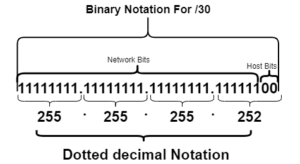
The dotted decimal notation for a /30 subnet mask is 255.255.255.252.. This representation is gotten by setting the first 30 bits of the 32-bit IPv4 address to ‘1s’, setting the remaining 2 bits to ‘0s’, and converting from binary to decimals.

/30 Wildcard Mask
The wildcard mask for /30 prefix length is 0.0.0.3. This is gotten by subtracting each octet of the subnet mask from 255.
Subnetting Class C Network with /30 Subnet Mask
To subnet a Class C network with a /30 prefix length, 6 bits are borrowed from the host bits and added to the network bits, leaving 2 bits for the host bits.
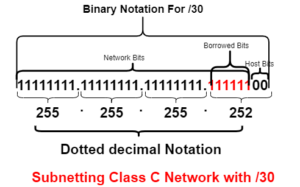
Therefore, when a class C network is subnetted with a /30 subnet mask, we will obtain the following number of subnetworks:
2^6 = 64
Hence, a /30 subnet mask will divide a class C network into 64 subnetworks, with each subnetwork having 4 ranges of IP addresses.
Subnetting Class B Network with /30 Subnet Mask
To subnet a Class B network with /30 subnet mask, 14 bits are borrowed from the host bits and added to the network bits.
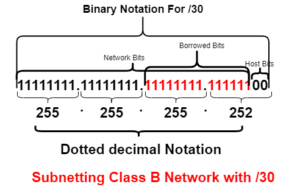
Hence, the number of subnets obtainable when we subnet a class B network with a /30 prefix length is obtained as follows:
2^14 = 16384.
Therefore, a /30 prefix length will divide a class B network into 16384 subnetworks, with each subnetwork having 4 ranges of IP addresses.
Subnetting Class A Network with /30 Subnet Mask
To subnet a class A network with a /30 prefix length, 22 bits need to be borrowed from the host bits and added to the network bits.
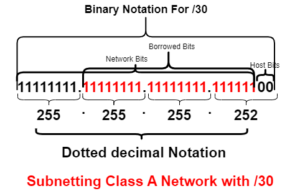
So, the number of subnetworks obtainable when we subnet a Class A network with a /30 subnet mask is given by:
2^22 = 4194304
Therefore, a /30 subnet mask will divide a Class A network into 4194304 subnetworks, with each subnetwork having 4 ranges of IP addresses.
How Many host in /30
There are a total of 4 ranges of IP addresses in a /30 prefix length. The first IP address in this range is the network address, and the last IP address in this range is the broadcast IP address. Therefore, there are 2 IP addresses that can be assigned to a host in a /30 subnet mask.
How Many Subnets in /30
The number of subnetworks obtainable when we subnet with a /30 subnet mask depends on the class of the network. Class C networks yield 64 subnetworks; class B networks yields 16384 subnetworks; and class A networks yield 4194304 subnetworks when subnetted with the /30 prefix length.

I am a passionate Networking Associate specializing in Telecommunications.
With a degree in Electronic engineering, I possess a strong understanding of electronic systems and the intricacies of telecommunications networks. I gained practical experience and valuable insights working for a prominent telecommunications company.
Additionally, I hold certifications in networking, which have solidified my expertise in network architecture, protocols, and optimization.
Through my writing skills, I aim to provide accurate and valuable knowledge in the networking field.
Connect with me on social media using the links below for more insights.
You can contact me using [email protected] or connect with me using any of the social media account linked below